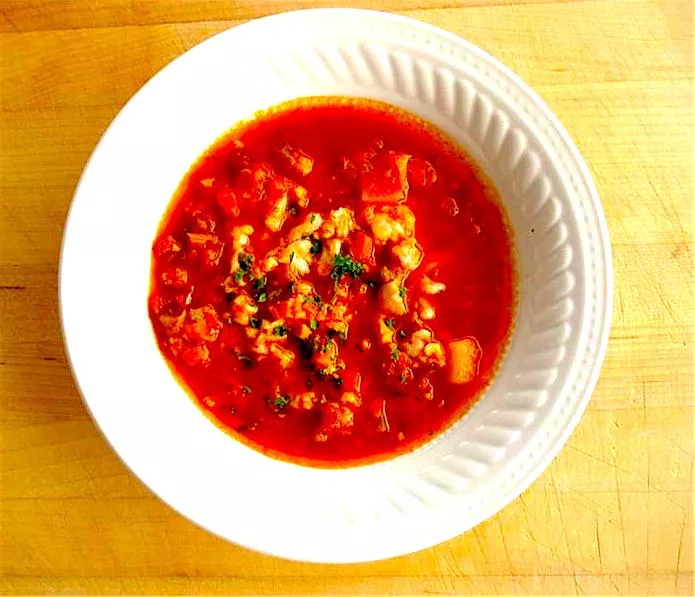
Citizens, it is time to turn our collective eyes to the southernmost reaches of Florida, which is home to one of the most delectable seafood chowders in the U.S.: the legendary conch chowder of Key West! 🙂
As noted on the blog whatscookingamerica.net:
“In the early 1800s, people from the Bahamas began migrating to the Keys. These immigrants were called conchs because of the sea snail they like to eat of the same name that was their staple food. By 1891, it is estimated that a third of the Key West population was Bahamian. This explains why the word conch is so much a part of the area’s heritage. Natives of Key West, Florida, and the Bahamas proudly call themselves Conchs.
Did you know: The name “conch,” pronounced “conk” is widely used in the Florida Keys to refer to a lifelong resident of the Keys. Native people born in Key West and the Bahamas call themselves conchs. In times past, proud parents in Key West placed a conch shell on a stick in the front of their house to inform neighbors of a new born infant.
People who take up residence in the Keys are humorously referred to as freshwater conchs. Politicians sometimes issue certificates to people active in community interests declaring them “honorary conchs”. Locals like being called conchs and take pride in the appellation. Source: Florida Keys Best.”
Conch is a common name that is applied to a number of different medium to large-sized sea snails that are used for food in the West Indies, and Key West region of Florida as well as Asia. In 1985, the harvesting of the conch was banned, and it is now illegal to take live conch in U.S. waters, where they are an endangered species. As a result, most conch now comes from the various Caribbean islands, including the Bahamas (where it is sometimes called ‘hurricane ham’).
Conch is FEROCIOUSLY tough and must be tenderized before eating – usually by beating it thoroughly with a mallet.
My version of this delicious chowder includes a respectful nod to North Florida with its use of the local datil pepper hot sauce and several other TFD tweaks! Datil hot sauce is a MUST for this recipe, please for the love of God and heaven alike, DON’T substitute this key ingredient. It’s a core falvor component in the recipe and you can easily buy datil hot sauce form here.
The history of the datil pepper is forever intertwined with the history of St. Augustine, Florida btw!
The datil is a very hot pepper, a variety of the species Capsicum chinense (syn. Capsicum sinense). Datil peppers are cultivated throughout the United States and elsewhere, but the majority are produced in St. Augustine, Florida. Many myths attempt to explain the origin of the datil pepper: some suggest the peppers were brought to St. Augustine by indentured workers from Minorca in the late 18th century, others posit that they were brought from Cuba around 1880 by a jelly maker named S. B. Valls.
The datil pepper is a green to yellowish-golden aromatic hot pepper belonging to the species of Capsicum chinense and is mainly produced and grown in St. Augustine, Florida. A mature datil pepper is 3-4 cm long with a blunt tip, a golden-orange color and weighs 3 grams. Its taste is a mix of both hot and sweet. The name datil was derived from the Spanish and Catalan language meaning date palm, because the shape of a datil pepper resembles it.
The origin of the datil pepper began after the Treaty of Paris in 1763. Over 100,000 acres of land was obtained by Andrew Turnbull, a Scotsman, and lead numerous families of workers from Mediterranean countries to Florida via Minorca, which is a Spanish island acquired by the British. This Floridian land was later established by Turnbull as New Smyrna. Turnbull later continued to search for more newcomers whilst many Greek conscripts were left in Mahon, Minorca.
The Minorcans felt an absence of civil and religious rights in Minorca, therefore decided to explore better living options in America. For a year, Turnbull recruited 1400 colonists and voyaged across to Florida. 450 Mediterranean people died from the dangerous circumstances of the voyage. The environment in New Smyrna was also not optimal for living and working, which resulted in survivors fleeing north to St. Augustine.
After the American Revolution, the remainders living in St. Augustine gained possession of a few acres of land and slaves. Historic research suggest that the datil pepper was journeyed through St. Augustine from Minorca. Others believe that the peppers were received through Turnbull’s slaves, the Mandingos. There were no Capsicum chinense being cultivated at this time in the Mediterranean region, further suggesting that the pepper originated elsewhere and not in Minorca.
Other origin stories argue that slaves from New Smyrna were in West Indies, where an abundance of common peppers were accessible. It is said that Mandingos were transported from West Indian slave markets via British ships, such as from Havana to Florida. The strong priorities of seasoning for Africans influenced the British slaves to incorporate chilies into their staple foods.
Chili peppers were loaded on to ship vessels along with the slaves. Trading via ships is the next nearest source of the datil pepper arriving in Florida because of trading from Cuba and West Indies along the North American coast. From there, the datil pepper seeds could be grown to provide a plentiful supply. Research deduced that there is a possibility that the St. Augustine datil pepper belongs to the same plant and species such as the Habanero pepper. However, it is improbable that the pepper was given to the Minorcans from the Africans in New Smyrna because it had little connections with Cuba.
In September 2013, Daniel Cantliffe, a professor of Horticultural Sciences, presented to the St Johns County Commission and stated, “The one thing I want to make completely clear to everyone: St Johns County is the only place on the planet that this plant, the Datil, has come from … It originated and came from St. Augustine. We have looked around the planet; we can’t find it anywhere else.” St Johns County still resides roughly 25,000 to 26,000 Minorcan descendants.
Please enjoy this rare recipe treat from the deepest of the deep South, My Citizens!
2lbs. conch - note that conch meat can be extremely tough, even if you dice it very small, so it needs to go through the medium-fine plate of a meat grinder. Also cut away any orange flaplike meat if that has not already been removed. Conch meat can usually be found in the frozen food section of your store.
2quartswater
1 tablespoon white vinegar
1 tablespoon Datil hot sauce (preferred) or Habanero hot sauce (TFD digs the spicy)
3lbs. white potatoes, peeled and sliced
Key West Old Sour on the side for additional seasoning by each guest
Instructions
In a large skillet, fry the salt pork over medium heat. Add the onions, garlic, celery, carrots and red/green peppers; saute until tender.
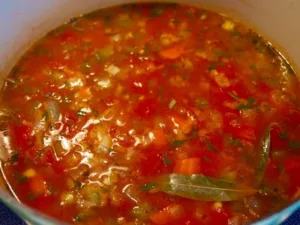
Add parsley, thyme, tomatoes, tomato paste, poultry seasoning, allspice, bbq sauce, oregano, salt and pepper and bay leaves. Simmer over low heat for 10 minutes.
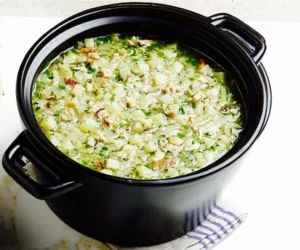
In a 6-quart Dutch oven combine two quarts water, hot sauce and vinegar; bring to a boil. Stir in the conch and tomato and spice mixture and simmer about two hours. Add sliced potatoes and simmer 20 to 30 minutes until potatoes are tender. Remove bay leaves before serving. Serve hot and garnished with fresh parsley.
How useful was this post, Citizen?
Click to rate My Recipe, Citizen - 5 hearts are ALWAYS appreciated!
Average rating / 5. Vote count:
No votes so far! Be the first to rate this post.
As you found this post useful...
Follow us on social media, Citizen!
We are sorry that this post was not useful for you!










Comments